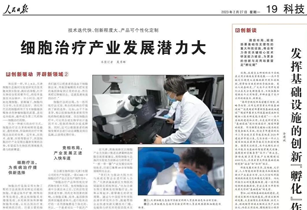
As usual, at 8 o'clock in the morning, Zhang Yingchi, a researcher at Tianjin Cell Ecology Haihe Laboratory, came to the laboratory, changed into clean clothes, turned on the ultraviolet lamp of the biosafety cabinet, and placed the culture medium in the water bath. Half an hour later, he started processing the cells. Under the microscope, the cells were evenly distributed and growing in good condition. The cells after digestion and passage will be used to provide T cells with weapons that can kill tumor cells, and then move toward clinical practice, eventually becoming third-generation drugs—cell therapy drugs.
As an emerging treatment modality, cell therapy has shown good results in the treatment of many diseases, especially cancer, genetic diseases, and infectious diseases. In recent years, driven by technology, policy, and market, my country's cell therapy industry has shown a booming development trend and is expected to become a new track with great potential in the field of biomedicine.
Cell therapy provides new options for disease treatment
Cell therapy refers to the use of bioengineering methods to obtain cells with specific functions, and through in vitro amplification, special culture and other treatments, these cells can enhance immunity, kill pathogens and tumor cells, etc., so as to achieve the purpose of treating certain diseases. At present, the main cell therapy methods are immune cell therapy and stem cell therapy."Immune cell therapy generally refers to the targeted treatment of certain types of immune cells, such as T cells and NK cells, outside the body and then infusing them back into the human body, so that they can kill tumor cells and eliminate viruses." Zhang Yingchi said that stem cell therapy involves transplanting healthy stem cells into the patient's body to repair diseased cells or rebuild normal cell tissues. The types of stem cells commonly used clinically are mainly mesenchymal stem cells, hematopoietic stem cells, neural stem cells, etc.Stem cells have become one of the core areas of cell therapy research due to their functions such as multi-lineage differentiation, immune regulation and secretion of cytokines. In recent years, the development of genetic engineering technology has improved the targeting of cell therapy and promoted the combined development of cell therapy and gene therapy. In vitro gene therapy and vector gene therapy have emerged.Zhang Yingchi gave an example: "Some diseases related to the hematopoietic system are generally caused by abnormalities in hematopoietic stem cells and mutations in some genes. At this time, we can take out the patient's hematopoietic stem cells, use gene editing technology to repair the mutated genes to a normal state, and then transplant them back. This is ex vivo gene therapy."The emergence of cell therapy has provided new options for the treatment of some diseases for which traditional therapies are ineffective and refractory. For example, due to individual differences, it is difficult to control the optimal dosage of traditional medicines for each patient. However, in cell therapy, synthetic biology can be used to design genetic switches to control the synthesis or release of drugs. At the same time, dynamic adjustments and prognosis monitoring can be made based on the patient's disease development status to obtain long-term efficacy.
Competition for layout, industrial development is entering the fast lane
"Cell therapy products are very different from traditional chemical drugs. After immune cells are separated from the blood, their activity is affected by factors such as the patient's age and medication history. From cell collection, culture, genetic modification to reinfusion into the patient, a series of measures for clinical treatment are individualized. Therefore, one patient corresponds to a batch of products, which requires personalized customization." Technician Yang Sen said that safety requirements are very high in the entire process, and the consumables are disposable.Compared with traditional chemical drugs, cell therapy products have the characteristics of rapid technological iteration, great innovation potential, high clinical dependence, and product customization, and many countries are competing to deploy them.Currently, the development of the global cell therapy industry is entering a fast lane. According to statistics, by the beginning of 2022, there will be a total of 33 approved cell therapy products in the world, including 12 immune cell products and 21 stem cell products.The development of cell therapy in my country is relatively short, but it is very vigorous. In recent years, Beijing, Shanghai, Tianjin, Shenzhen and other places have vigorously developed the cell therapy industry. Shanghai launched the "Shanghai Action Plan to Promote Cell Therapy Technological Innovation and Industrial Development (2022-2024)", proposing to strive for the scale of Shanghai's cell therapy industry to reach 10 billion yuan by 2024. Last year, Shenzhen successively issued documents to support the development of the biomedical industry, focusing on supporting the high-quality development of industrial clusters including cell therapy drugs.In Tianjin, Binhai High-tech Zone uses the cell industry as a breakthrough to promote the high-quality construction of the Beijing-Tianjin-Hebei characteristic cell valley. It has formed a "one core, one belt and one circle" industrial development space layout system around the Haihe Laboratory of Cell Ecology as the innovation power core. Currently, it has gathered more than 40 companies related to the cell field."We vigorously promote in-depth cooperation between large institutes and high-growth enterprises." Zheng Chunlin, deputy director of the Biomedicine Bureau of Tianjin Binhai High-tech Zone, said, "For example, if immune cell therapy is started from scratch, it will require a long research and development cycle. By cooperating with the Institute of Hematology, Chinese Academy of Medical Sciences, it can not only help companies quickly break through key technology thresholds, but also help the institute's cutting-edge technology to realize the transformation of scientific and technological achievements."According to experts, in the field of immune cell therapy, the main field of cell therapy technology, my country has become the country with the largest number of clinical studies on CAR-T cell therapy in the world. According to relevant statistics, China's cell therapy market will grow from 1.3 billion yuan in 2021 to 58.4 billion yuan in 2030, with an average annual growth rate of 53%. It is expected that the next 10 years will be a period of rapid growth for the domestic cell therapy industry.
Standardize and support to promote the healthy and rapid development of the industry
After more than 10 years of development, my country's cell therapy field has entered a stage of standardized development.Cell therapy is considered a subdivided track for research and development in the field of innovative drugs. Relevant competent authorities have issued a number of application guidance related to cell therapy products in the past two years to promote the review and approval of related products. Domestic cell therapy products have received relatively clear guidance on all aspects from application to production. Local governments have also continued to introduce relevant policies to support and encourage the development and marketing of cell therapy products.At present, domestic research in the field of cell therapy has become an important force in global research and development. At the same time, experts believe that as an emerging industry, the cell therapy industry still faces many challenges. Although technology continues to make breakthroughs, it is not easy for cell therapy products to truly become popular. On the one hand, the industrial chain for the transformation and application of cell therapy technology is not mature enough, and on the other hand, its cost is still relatively high.Zheng Chunlin said: “If relevant equipment and consumables can be domestically produced, the cost of cell therapy products will be greatly reduced.” It is understood that many of the equipment involved in the R&D and production of domestic cell therapy products, as well as supporting cell culture consumables, still need to be imported.The shortage of clinical resources also restricts the clinical translation and application of cell therapy technology. Yan Fengying, deputy director of the Tianjin Institute of Materia Medica, said: "Compared with traditional chemical drugs, cell therapy products have many cell sources and types, and strict production and preparation process requirements. Therefore, it is necessary to establish a full chain of R&D, production, preclinical evaluation and clinical research that meets the characteristics of cell therapy products and is standardized. "Hui Lijian, a researcher at the Professional Innovation Center for Molecular Cell Science of the Chinese Academy of Sciences, suggested that in the process of innovation and transformation of cell therapy, new cell therapy technologies should be established through original innovation, and cell quality and safety evaluation, clinical research specifications and product standards should be improved, thereby promoting the clinical transformation and application of cell therapy and promoting the healthy and rapid development of the cell therapy industry.